

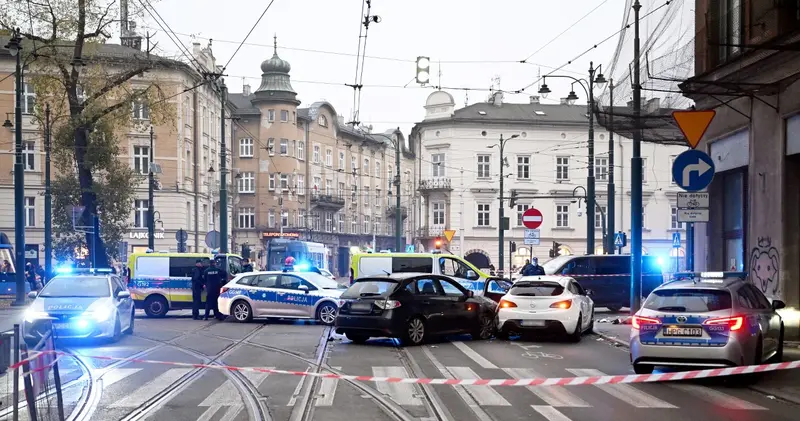
The Krakow shooting that killed six people and injured more than a dozen was followed within minutes by false claims online, Poland’s digital affairs minister said. The suspect later died in hospital, but investigators have not established his motive; meanwhile, officials say more than 2,000 accounts were reported for blocking or moderation in the first 24 hours.
The attack and the investigation
On November 7, 2026, an armed man drove a car onto Krakow’s Main Market Square and opened fire on passers-by. Police shot the suspect, 24-year-old Michał O., during an intervention near Stradomska Street, detained him and took him to hospital. He died early on November 9 after several operations; doctors had described his condition as critical.
Prosecutors classified the attack as an act of a terrorist nature. Investigators were still establishing how it unfolded and what motivated the attacker. The sources available so far do not establish a motive.
False claims spread as officials urged caution
Krzysztof Gawkowski, Poland’s minister of digital affairs, said false information began appearing online within tens of minutes of the shooting. He said politicians and people he described as pseudo-journalists spread false claims, which Russian accounts then amplified. Gawkowski also said Russian bots and trolls repeated Polish posts as if they were true, and that Russian support for these narratives had been identified.
NASK, Poland’s research institute responsible for monitoring online disinformation, identified several false narratives. They included claims that the Polish government planned the attack with EU support to help cancel the Independence March, that the suspect was a soldier, and that the shooting was linked to protests outside the Constitutional Tribunal. NASK also listed false claims about Ukrainian links and suggestions that the attack had been staged with actors. The claim that the suspect was a soldier reportedly reached nearly 18 million; the protest claim reached up to 14 million.
Gawkowski said more than 2,000 user accounts were reported for blocking or content moderation during the first 24 hours, and that the number was rising. He urged people to check information against official sources and report suspicious material to CERT Polska.
How reports about the suspect’s views entered Poland’s political debate
Poland’s interior minister, Marcin Kierwiński, initially said the suspect had very radical views and was fascinated by far-right ideologies. The ministry later urged restraint until prosecutors issued official findings. That distinction matters: the early description has not established the attacker’s motive.
Frankfurter Allgemeine Zeitung commentator Reinhard Veser said the first reactions exposed deep political divisions, with conspiracy theories circulating in right-wing circles over the weekend. Süddeutsche Zeitung correspondent Victoria Grossmann reported that PiS lawmakers and media linked to the party quickly accused the police and government of inaction. She also cited criticism by Polish newspapers Rzeczpospolita and Gazeta Wyborcza of using the tragedy for political purposes.
Veser said the November 11 Independence March in Warsaw would be a test for public debate. He argued that if reports of a far-right motive are confirmed, both sides may be tempted to use the attack for political ends. For now, prosecutors have yet to establish that motive.
Comments
To comment, sign in or create an account. Sign in Create an account
No comments yet.