

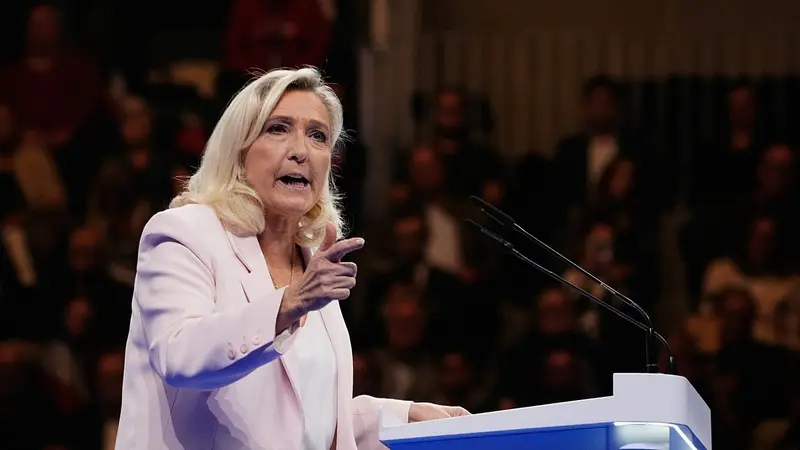
Marine Le Pen told Ukraine’s ambassador to France on Monday that she would end French financial assistance to Kyiv if she wins the 2027 presidential election, while honouring commitments already made. The pledge puts a possible change in French policy on Ukraine at the centre of the campaign, as European governments debate long-term support for the country.
Le Pen, leader of the far-right National Rally, cited the state of France’s public finances. The party said existing commitments would remain in place, including commitments related to the European Union’s €90 billion support loan, as well as material donations, humanitarian aid and diplomacy.
The party did not specify which forms of financial assistance would stop or set out the precise scope of the commitments it would maintain.
An earlier pledge set a six-month timeline
In an earlier interview with Belgian broadcaster VRT, Le Pen said aid would continue for six months after she took office, then financial assistance would stop because France did not have the money. It is not clear how that timetable would fit with the commitments the National Rally now says it would honour.
Le Pen met ambassador Vadym Omelchenko in Paris. She described the talks as cordial and said they gave her an opportunity to reaffirm her support for Ukraine. She also said that seeking peace should remain a priority, while acknowledging that it would be difficult to achieve.
France is one of Ukraine’s strongest military supporters and backs continued EU financial assistance, according to the Kyiv Post. Le Pen has said she supports continued military assistance even as she seeks to end French financial aid. The distinction matters: her pledge concerns financial assistance, and the party has said existing commitments would be honoured.
Ukraine policy is a campaign issue
Le Pen is leading the polls ahead of the 2027 vote. An Elabe survey published on November 14 put her at around 32%, compared with roughly 17% for Jean-Luc Mélenchon, leader of the left-wing France Unbowed party.
President Emmanuel Macron warned that limiting resources for Ukraine would push it towards an unjust peace and leave both Ukraine and Europe vulnerable. Zelensky, meanwhile, pushed back against Le Pen’s position last month, stressing the value of defence cooperation between France and Ukraine.
Le Pen’s stance has also drawn scrutiny because of her past ties to Russia. She met Russian President Vladimir Putin at the Kremlin in 2017, and the National Rally took a loan from a Russian bank that it repaid in full in 2023. Before Russia’s full-scale invasion, she said the occupation of Crimea was not illegal. She has also opposed Ukraine joining the EU and expressed scepticism about future EU aid if it burdens France.
The Kiel Institute for the World Economy has estimated France’s total support for Ukraine since 2022 at about €27 billion, including bilateral and EU contributions as well as military, financial and humanitarian assistance.

Comments
To comment, sign in or create an account. Sign in Create an account
No comments yet.