
Russian strikes across Ukraine killed and injured civilians on Sunday, September 27, while damaging homes, industrial facilities and communications infrastructure, Ukrainian authorities and local officials said. Reports described attacks in Sumy, Kyiv and the Odesa region. New accounts also detailed a sustained series of attacks on Ukrainian internet, hosting and media infrastructure between September 23 and 27.
In the northern city of Sumy, three Russian aerial bombs struck the central area during the afternoon, hitting a children’s center, according to Ukrainian officials cited by local media. Two people were killed, including a 16-year-old girl, and five others were injured.
Casualties and damage in Kyiv
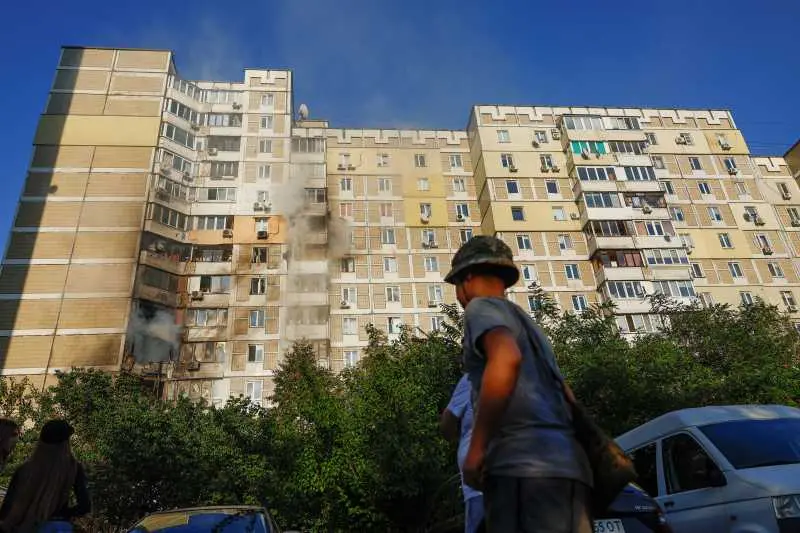
Drone attacks also targeted Kyiv and surrounding areas. Local authorities reported that one person was killed and four were injured. More than 16 residential and industrial buildings in the Kyiv region were damaged, while a non-residential building and a service station were among the sites affected in the capital. A drone also struck a nine-storey apartment building, according to one report.
The reports contain differing casualty figures for Kyiv because they refer to separate updates and time periods. A statement attributed to Kyiv Mayor Vitali Klitschko said that seven people had been killed and 59 injured in overnight attacks, while a later local tally cited one death and four injuries in Kyiv and its outskirts.
President Volodymyr Zelensky said Russian drones had damaged schools, kindergartens, a residential building, a repair shop, warehouses and communications facilities in Kyiv. He described the attacks as part of what he called a campaign against ordinary life. His account could not be independently verified.
A widening assault on communications networks
Reports said a drone hit a data center operated by UTELS, a provider serving Kyiv and the surrounding area, forcing a partial shutdown of core network equipment. About 100,000 households were reportedly left with partial or complete loss of internet access. Attacks from September 23 to 26 also affected the infrastructure of several providers and hosting companies, including Pavutyna, Domonet, Kievnet, Faust and MiroHos.
Cosmonova, a Kyiv data center described as a major Ukrainian internet-exchange facility, was reportedly hit several times on September 25 and 26. Its operators said the backbone was damaged and that the facility suffered losses so severe that services could be restored only partly through relocation. Several media companies and television channels subsequently became partly or completely unavailable.
Other reports, citing Russian officials, said strikes hit data centers linked to Ukrtelecom, DreamLine and Vodafone Ukraine, as well as infrastructure associated with Kyivstar and Omega Telecom. Kyivstar said its Kyiv headquarters sustained building damage but that there were no casualties. Vodafone Ukraine had not confirmed the reported strike on its data center. The accounts did not establish that every facility was hit in the same incident.
Earlier reports said a Datagroup data center in Kyiv had been damaged, although the company said services continued from backup sites. Russian officials said a facility containing a data center had been used by Ukrainian military intelligence. That claim was not independently verified. Ukrainian officials said data and communications infrastructure was essential to civilian life, including the rapid transmission of warnings about missile and drone attacks.
Logistics, military and maritime targets
Russian officials said the attacks also struck fuel-supply facilities in Kyiv and the infrastructure of the Vasylkiv military airfield. They listed a Nova Poshta logistics center in the Odesa region among the targets, while another report said a Zammler warehouse in the Kyiv region stored and distributed Western military aid. Damage and the alleged presence of military cargo at the sites were not independently verified.
The Russian account also listed a vessel carrying military and dual-use cargo at the port of Chornomorsk, infrastructure at the Danubesudoservice shipbuilding plant in the port of Izmail, a Ukrainian border guard facility and a vessel carrying military cargo toward Odesa. A separate report, citing Russian claims, said two attack-UAV storage facilities were destroyed in Mykolaiv region and an interceptor-UAV storage facility was hit in Odesa. Those claims could not be independently verified.
Strikes and counterclaims
Authorities in the Odesa region reported a Russian attack that killed at least one person and damaged civilian and industrial infrastructure. The broader event summary placed the toll from a mass attack in the region at 14 dead and 57 injured, but that figure is not reflected in the supplied local reports, which mention one death and several injuries.
Zelensky said that Russia had launched more than 2,200 long-range drones, about 1,650 aerial bombs and 38 missiles against Ukraine during the previous week. The figures were provided by the Ukrainian president and were not independently verified.
The supplied event summary also reports deaths and injuries in the Zaporizhzhia region and a fatal Russian airstrike in Shabelkivka, in the Kramatorsk district of Donetsk region. Those details were not described in the supplied local reports, which instead cited a Russian-installed official’s claim that a Ukrainian drone killed a woman in occupied Enerhodar, in Zaporizhzhia region.
The attacks came as fighting continued without a breakthrough in United States-backed negotiations. Russian Foreign Minister Sergey Lavrov said at the United Nations that Moscow intended to continue its military campaign “to the end,” according to the reports.



Comments
To comment, sign in or create an account. Sign in Create an account
No comments yet.