
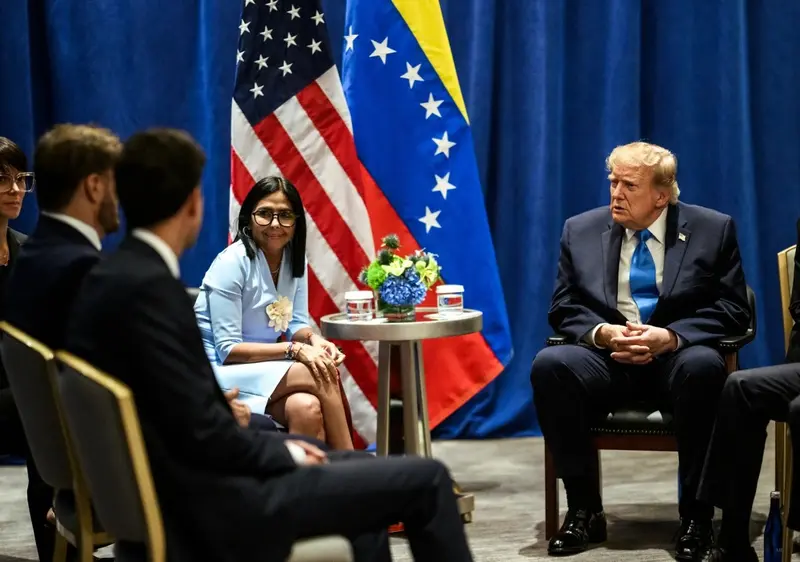
U.S. President Donald Trump confirmed that he discussed the elections in Venezuela with the country’s interim leader, Delcy Rodríguez. Their meeting took place on Tuesday, September 22, in New York on the sidelines of the UN General Assembly and marked the first reported face-to-face contact between the two leaders since the change in power in Venezuela in January.
“Yes, we talked about the elections. By the way, she was very gracious and wonderful,” Trump told reporters on Saturday, September 26, in the White House gardens. He also noted the cooperation between Washington and Caracas in the oil sector and stated that it generates significant revenue for the Venezuelan people.
No election date has been announced
Rodríguez addressed the topic of elections the day after the meeting—on September 23—while speaking at the 81st session of the UN General Assembly. She stated that “there will be elections in Venezuela” and that the country is undergoing a democratic transformation, but she did not specify a date for the vote or present an election calendar.
Trump confirmed that the elections had been discussed but did not report any agreement on the timing or procedure for the vote. U.S. Secretary of State Marco Rubio stated that the meeting was brief and that the elections were just one of the topics discussed.
Rubio emphasized that Washington is interested in more than just holding an election. According to him, the conditions necessary for a “viable republic” must be in place—the restoration of state institutions and the economy, as well as addressing Venezuela’s external debt.
“We want not only free and fair elections to take place, but also for a sustainable republic to exist,” Rubio said.
Financial Talks in New York
During her visit, Rodríguez also met with International Monetary Fund Managing Director Kristalina Georgieva, World Bank President Ajay Banga, and Inter-American Development Bank President Ilan Goldfajn. The talks focused on the resumption of financing, technical cooperation, economic recovery, and the restructuring of Venezuela’s external debt.
In her conversation with Georgieva, they discussed the release of $346 million of Venezuela’s own funds held in the form of special drawing rights. According to a new report, these funds are planned to be directed toward assisting areas affected by the earthquakes in June 2026. At the meeting with Banga, technical and financial assistance to priority sectors was discussed, while the discussion with Goldfain focused on cooperation and the normalization of institutional relations.
The Inter-American Development Bank is considering a two-year plan for potential financing of up to $2.5 billion. It provides for support for the energy sector and social programs, as well as the dispatch of technical missions to assess Venezuela’s needs. Implementation of the plan depends on resolving the issue of past debts and verifying the country’s macroeconomic data. According to the report, Venezuela has been in default since 2017, and its debt to the Inter-American Development Bank amounts to approximately $2 billion. The bank suspended lending to the country in May 2018.
Oil, Gold, and the Risks of Rapprochement
Negotiations between Washington and Caracas also touched on energy, mineral extraction, security, debt, and economic recovery. The scope of potential U.S. involvement in Venezuela’s oil sector has been described in various ways: among other things, there have been reports of a share of reserves and rights to 17 fields with proven reserves of about 65 billion barrels.
New reports have added gold agreements to the resource agenda. The Trump administration has authorized traders to import Venezuelan gold, although some of the metal is alleged to have been linked to miners who paid bribes to criminal groups. The report states that hundreds of millions of dollars’ worth of gold remains in storage: refiners must ensure that the metal has not financed gangs, environmental destruction, or corruption.
It is also reported that American financiers are investing in a mine linked to criminal groups. The White House has stated that Western companies can help clean up and legitimize Venezuela’s mining industry. Critics warn that such agreements could benefit criminal networks and prioritize access to resources over democratic safeguards.
Oil cooperation has also faced criticism from those who believe that Washington is prioritizing access to Venezuelan resources over a democratic transition. Trump presents the energy agreements as a source of revenue for Venezuelans, but the final terms of the deals have not been made public.
The Opposition and the Political Process
Questions remain about the opposition’s participation in the political process. María Corina Machado, who is in Panama, stated on the day of the meeting between Trump and Rodríguez that she had been prevented from returning to Venezuela three times. Rubio spoke of the need to restore conditions for political life, referring not only to Machado but also to other politicians remaining outside the country.
Representatives of the 2015 National Assembly are also participating in consultations with the interim authorities on the restoration of Venezuelan institutions. The details of these discussions and their possible outcomes have not been made public.
The meeting in New York marked a significant expansion of contacts between Washington and Caracas following Maduro’s seizure of power during a military operation on January 3. The parties have publicly confirmed that they are discussing elections and share a general intention to continue the dialogue; however, the timing of the vote, the rules for participation, and the final parameters of the political and economic transition have not yet been determined.
Comments
To comment, sign in or create an account. Sign in Create an account
No comments yet.