
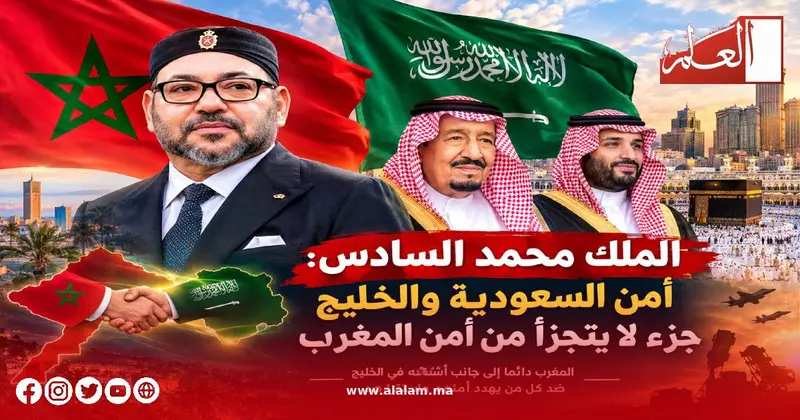
King Mohammed VI of Morocco sent two official telegrams to King Salman ibn Abdulaziz Al Saud of Saudi Arabia and to the Crown Prince, Chairman of the Council of Ministers Mohammed bin Salman bin Abdulaziz Al Saud. In the messages, he expressed Morocco’s full solidarity with Saudi Arabia and condemned the repeated attacks attributed to Houthi groups.
Mohammed VI spoke on his own behalf and on behalf of the Moroccan people. He described the relationship between Morocco and Saudi Arabia as religious, historical, and based on a shared destiny, noting that these ties require a joint commitment to defending the truth, sovereignty, security, and Muslim holy sites.
Concern Over Attacks on Civilian Targets
According to the king, the attacks are directed against civilian and economic targets, vital infrastructure, cities, and residential areas in Saudi Arabia. He stated that the desperate attempts to attack the two holiest sites in Islam—Mecca and Medina—are of particular concern.
The telegrams state that the attacks are not limited to Saudi Arabian targets and citizens. They offend the sensibilities of more than 1.8 billion Muslims worldwide, as well as those performing the Umrah in the Kingdom. Mohammed VI called these actions a violation of Islamic values, including peace, tolerance, and respect for human life, dignity, and holy sites.
“Any attack on Saudi Arabia is an attack on Morocco,” Mohammed VI stated in the messages.
Saudi Arabia’s security is linked to Morocco’s security
The Moroccan monarch emphasized that the security and stability of Saudi Arabia, as well as those of other member states of the Gulf Cooperation Council, are an integral part of Morocco’s security. According to him, supporting Saudi Arabia and the Arab Gulf states means defending truth and the rule of law, while defending their vital interests means defending shared strategic interests.
Mohammed VI reaffirmed Morocco’s unwavering support for Saudi Arabia in the face of regional threats. He cited the actions of terrorist and separatist groups and the regional forces supporting them, which, he said, seek to undermine the security of neighboring countries and the region as a whole.
The king stated that these actions threaten the stability of the entire region and vital maritime routes, which are of great importance to the global economy and the security of international shipping. The published materials do not provide independent data on the timing, specific targets, or consequences of the attacks.
Call for Accountability and Sanctions
Mohammed VI placed full responsibility for the attacks on Houthi forces, as well as on those who support, finance, and arm them. He emphasized the need to hold the perpetrators accountable under international law and called for the imposition of international sanctions.
The king called the continued attacks a clear violation of international law and relevant UN Security Council resolutions. The telegrams referenced Resolution 2216 of 2015 and Resolution 2722 of 2024, which concerns attacks on maritime shipping.
Morocco also stated that strikes against the civilian population, economic infrastructure, and holy sites constitute a serious violation of international humanitarian law and international conventions. Mohammed VI emphasized that such actions must not go unpunished and must be held accountable in accordance with international law.
Regional Security Context
Rabat’s position came amid ongoing concerns about the security of maritime routes in the Red Sea and the Bab el-Mandeb Strait region. Morocco presented the security of Saudi Arabia and the Gulf states as closely linked to its own strategic interests and called for a unified response to threats to sovereignty, security, and religious sites.

Comments
To comment, sign in or create an account. Sign in Create an account
No comments yet.