
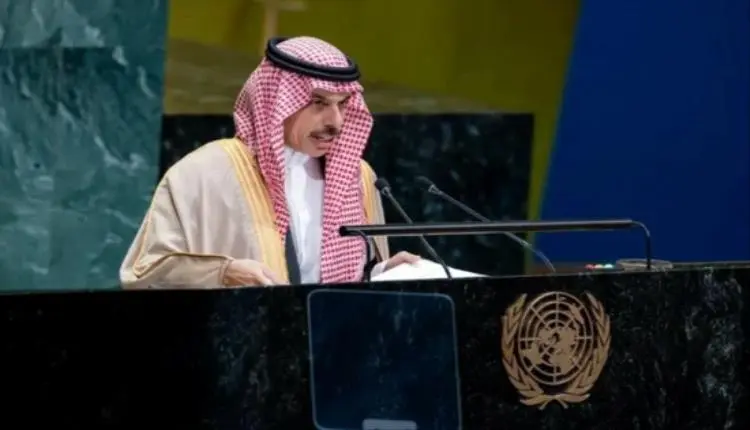
Saudi Arabia retains the “full right” to defend its security, sovereignty, citizens, residents, and national resources, said the kingdom’s foreign minister, Prince Faisal bin Farhan Al Saud. He spoke on September 26 in New York at the 81st session of the UN General Assembly.
The minister said that Saudi Arabia and other countries in the region have been subjected to what he called “brutal Iranian attacks” targeting their security, resources, and civilian and economic infrastructure. He called on the international community to fulfill its responsibilities in the face of threats to international peace and security.
Faisal bin Farhan stated that the security of the Persian Gulf is inseparable from the security of the region and the world as a whole. According to him, the stability of this region is directly linked to global energy security, international trade, and the resilience of global supply chains.
Call to Ensure Freedom of Navigation
Saudi Arabia called for the protection of freedom of navigation in all major international waterways, particularly the Strait of Hormuz, the Bab el-Mandeb Strait, the Red Sea, and the Gulf of Aden. Riyadh demanded that the situation in the Strait of Hormuz be restored to the state it was in prior to February 28 and that no fees or restrictions be imposed.
The Kingdom rejected the use of vital maritime routes as a tool for exerting pressure, making threats, or harming the interests of states. Restoring security and stability, the minister stated, must be based not on domination, the imposition of influence, or the exploitation of crises, but on mutual respect, shared interests, good-neighborliness, respect for sovereignty, and international law.
The protection of international shipping and the resilience of global supply chains, the minister said, are a shared responsibility and require serious international cooperation. Saudi Arabia also supported initiatives to de-escalate tensions, particularly the efforts of Qatar, Pakistan, and other friendly and allied countries aimed at creating conditions for dialogue and diplomacy.
Faisal bin Farhan called for regional security measures to be comprehensive, effective, and sustainable. He also advocated for a region completely free of weapons of mass destruction and stated that peaceful nuclear programs must be subject to international control, verification, and safeguards.
Position on Regional Conflicts
On the Palestinian issue, Saudi Arabia rejected any attempts to forcibly displace Palestinians or alter the reality on the ground in Palestinian territories. The minister stated that a just and sustainable peace is possible only on the basis of a two-state solution—with the establishment of an independent Palestinian state within the 1967 borders and East Jerusalem as its capital. He described civilian casualties, obstacles to the delivery of humanitarian aid, and the expansion of settlements as serious violations of international law.
With regard to Yemen, the Kingdom supported a comprehensive political settlement that would ensure the country’s stability, bolster its economy, and alleviate humanitarian suffering. Saudi Arabia reported that it had provided Yemen with over $29 billion in humanitarian aid and development assistance and was the country’s largest humanitarian donor in 2025.
Riyadh welcomed the statement by members of the UN Security Council condemning the Houthi movement’s missile and drone attacks on the kingdom and commercial vessels. Saudi Arabia called on the international community to condemn the attacks and attempts to threaten shipping in the Red Sea and the Bab el-Mandeb Strait.
Regarding Sudan, Riyadh advocated for a Sudanese political solution that respects the country’s sovereignty and unity and supports its state institutions. The Kingdom expressed its support for measures to strengthen Syria’s security, stability, and territorial integrity and welcomed the United States’ decision to remove Syria from the list of state sponsors of terrorism.
Saudi Arabia also reaffirmed its support for the Lebanese State and its legitimate institutions, the implementation of the Taif Agreement, and the centralization of weapons under State control. With regard to Iraq, the Kingdom supported efforts to strengthen security, decision-making autonomy, and state control over weapons, stating that Iraqi territory should not be used to launch attacks on neighboring countries.
Economy and Energy
Speaking about the “Vision 2030” program, Saudi Arabia reported that non-oil activities accounted for 55% of non-oil GDP. Unemployment among Saudis, according to the kingdom, fell from 12.3% in 2016 to 6.4% in 2026.
The minister stated that Saudi Arabia’s investments and infrastructure helped maintain energy supplies during disruptions to maritime traffic through the Strait of Hormuz. He cited the East-West Pipeline and oil reserves outside the region, which helped mitigate the impact of the disruptions. The kingdom also reported expansion in emissions control technologies, renewable energy, and clean hydrogen production.
Support from the Cooperation Council
Jassim Mohammed Al-Budaivi, Secretary-General of the Cooperation Council for the Arab States of the Gulf, expressed full support for Saudi Arabia’s measures to protect its security, sovereignty, and territorial integrity.
Al-Budaivi condemned the Houthi attacks using ballistic missiles and drones, which he said targeted Riyadh and Khamis Mushait. He called them a gross violation of Saudi Arabia’s sovereignty and a direct threat to the civilian population and regional stability.
The statements reflect the positions of Saudi Arabia and the Cooperation Council. There is no independent confirmation in publicly available sources of the allegations against Iran or details of the attacks mentioned.

Comments
To comment, sign in or create an account. Sign in Create an account
No comments yet.