

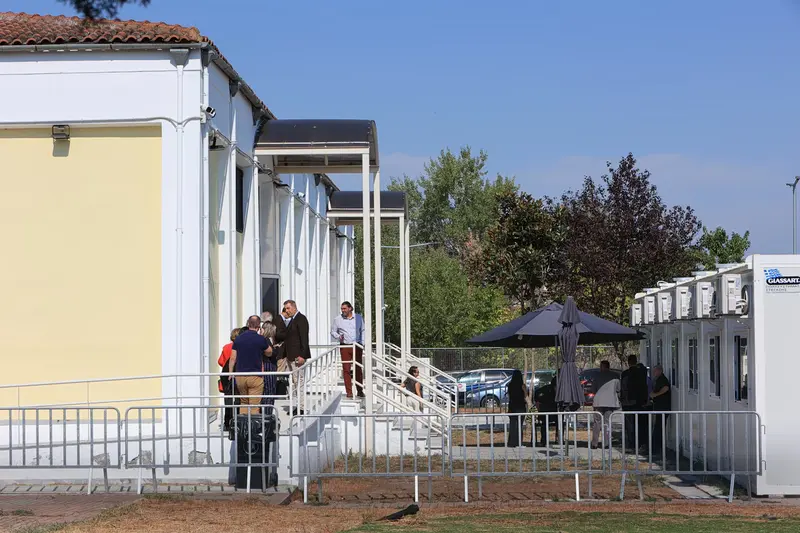
Elias Papangelis, whose daughter died in the Tempi train collision, testified in Larissa, Greece, on October 6. He said he had repeatedly asked investigators to examine phone records. His testimony followed a court decision authorizing forensic examination of the accused night-shift stationmaster’s phone.
Papangelis was the only witness to testify at the October 6 hearing and then answered lawyers’ questions. His daughter, 18-year-old Anastasia Papangelis, died in the February 28, 2023 crash along with 56 other people.
Father questions the investigation
Papangelis said he had repeatedly asked special appellate investigator Sotiris Bakaimis to examine phone records during the investigation. He said some people had not been examined. He also questioned why representatives of the companies TOMH-ALSTOM had not been called to testify about railway contract 717.
The trial has entered its fifth week of testimony from victims’ relatives. Three hearings were scheduled for the week beginning October 5, with 26 witnesses expected to testify.
Court authorizes phone examination
The court approved a request during the previous week to lift confidentiality protections on the accused night-shift stationmaster’s mobile phone. The Greek police’s forensic investigations department will examine incoming and outgoing calls, SMS and MMS messages, and communication-app data, including Viber. If examiners find deleted files, they are to attempt to recover them.
The court also ordered the seizure of the work phone belonging to Nikolaos Nalbantis, the passenger train’s assistant driver. Police must prepare a seizure report and submit it to the court. A final decision on whether to conduct a forensic examination of that device remains pending.
The court rejected a separate request to call two members of parliament, Adonis Georgiadis and Dimitris Markopoulos, as witnesses, a Greek news outlet reported.
Relatives raise safety and evidence concerns
At the October 5 hearing, the parents of Giorgos Papazoglou, a 22-year-old student, described railway safety deficiencies and shortcomings in the investigation. His mother, Despina Ganidou, said relatives had been forced to investigate for themselves. She said warnings about railway conditions had been ignored.
Ganidou said the trains travelled on a collision course for 12 minutes without any safety system operating. She also sought a full examination of the causes of the fireball and fire after the collision.
Eleni Vasara, mother of victim Agapi Tsaklidou, said her daughter’s forensic report contained omissions and contradictions. She said bone fragments she believed could belong to Agapi remained unidentified. Vasara asked the court to summon Panagiotis Terezakis, chief executive of the railway organization OSE.
Damianos Balasoulis, a lawyer supporting the prosecution, said relatives submitted three recordings of conversations between railway staff. He said the recordings highlighted serious operational problems.
Earlier testimony also addressed the lasting consequences for survivors. Dionysis Georgiadis testified the previous week about his son, Gerasimos-Iasonas Georgiadis, who remains in a coma. He described about three and a half years of care in medical facilities.

Comments
Comments are closed.