
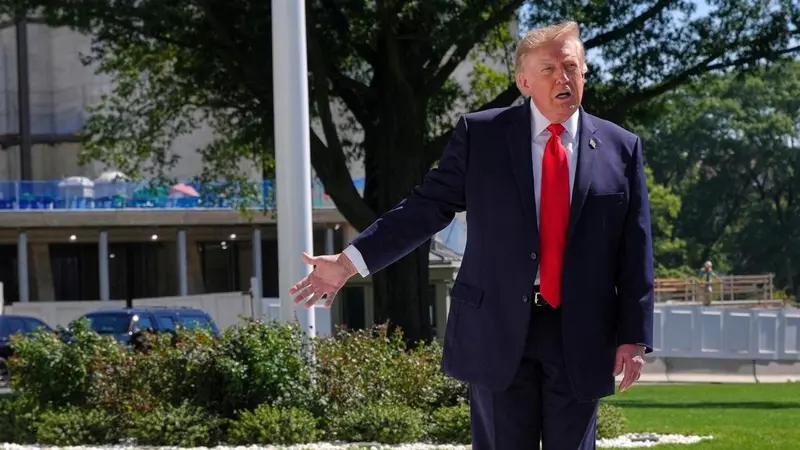
President Donald Trump has rejected Iran’s latest ceasefire proposal and said it was “possible” he would order an increase in bombing after the November midterm elections. His comments came in an interview with TIME conducted at the White House on Sept. 28, as the conflict with Iran entered its seventh month.
Trump said he wanted a “real deal” but considered Tehran’s offer insufficient. He cited a proposal to “open up the Strait” of Hormuz and said the broader terms were not good enough. Asked whether the United States would intensify its bombing campaign after the midterms, Trump replied, “Possible,” without specifying what action he might take.
Military deployments in the region
The United States is also increasing its naval presence in the Middle East. A U.S. official said a group of ships carrying more than 7,000 sailors and 2,000 Marines was heading to the region. The deployment includes the USS Theodore Roosevelt carrier strike group and the USS Makin Island amphibious readiness group.
The official, who spoke on condition of anonymity to discuss sensitive military operations, said the movement could mean that three U.S. aircraft carriers are in the region as early as the end of October. That would bring more than 20,000 U.S. sailors and Marines and hundreds of aircraft to the area, according to the official.
The USS George H.W. Bush and USS George Washington are currently in the region, alongside the USS Boxer amphibious readiness group, according to the report. The Washington moved from the Pacific to relieve the long-deployed USS Abraham Lincoln. The U.S. Navy previously had three carriers in the Middle East in April, the first such deployment since 2003.
Trump’s account of the conflict
Trump said he had initially expected the war to last six to eight weeks. He said it had continued into a seventh month because he chose to go further, adding that he wanted to prevent Iran from returning “in some different form.” He also said Iran wanted a deal and that he wanted an agreement on broader terms.
A separate report by SocialNews.XYZ, citing a CBS News segment, said Trump’s remarks contradicted his earlier comments about the war’s timeline. The report included analysis by Joseph Cirincione of the Council on Foreign Relations, but did not provide an independent account of the military situation.
Comments on Israel
In the TIME interview, Trump said he did not think Israeli Prime Minister Benjamin Netanyahu had been warned before the Oct. 7 Hamas attack. “I think if he would have known, he would have done something about it,” Trump said. He also said Hamas had not disarmed and that he would make an “appropriate decision” on the issue.
The statements leave the timing and scale of any possible further U.S. strikes unclear. The announced naval movements, however, point to a larger American military presence in the region in the coming weeks.

Comments
To comment, sign in or create an account. Sign in Create an account
No comments yet.