

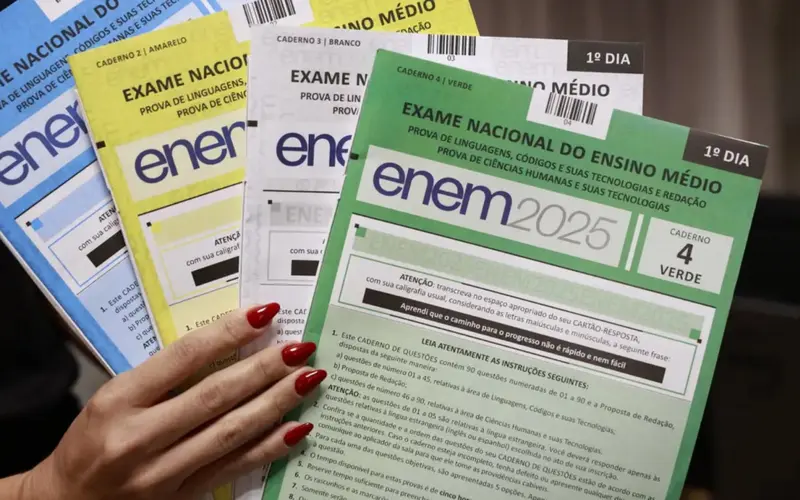
Brazil’s Enem 2026 is set to reach its final day on Sunday, November 15, with candidates due to take 90 questions in Mathematics and Natural Sciences. More than 5.05 million confirmed registrants are eligible to sit the exams, including people who missed the first day.
The exam is scheduled to run from 1:30 p.m. to 6:30 p.m. Brasília time. Candidates have five hours to answer 45 Mathematics questions and 45 covering Biology, Physics and Chemistry. The gates are due to open at noon and close at 1 p.m.; late arrivals will not be admitted. The exams are being held at the same locations as the first sitting, across 1,901 municipalities in Brazil’s 27 federative units.
What candidates can expect
Those with approved requests for extra time from Brazil’s education assessment institute, Inep, are entitled to an additional 60 minutes. Candidates approved to use a video exam in Brazilian Sign Language, known as Libras, receive an additional 120 minutes.
Frederico Kiyomi, a chemistry teacher and Natural Sciences coordinator at Colégio Sigma, said the exam tests reasoning and reading comprehension as well as subject knowledge. He noted that questions can include lengthy passages, graphs, tables and everyday situations that candidates must understand before applying a concept or calculation.
A report by ClicRDC said the testlet format, in which several questions share a text, graph or other material, could appear on the second day. Inep had not said which questions, if any, would use that format.
Why the results matter
Enem results are used by public and private institutions to select students for higher education. They can be used in federal programmes including Sisu, which allocates university places, Prouni, which offers scholarships, and Fies, a student financing programme. Institutions in Portugal that have agreements with Inep may also consider the scores.
Since the 2025 edition, candidates aged 18 or older have again been able to use Enem for high-school completion certification. The 2026 exam also has a new stated role: for the first time, it aims to assess skills expected at the end of high school as part of Brazil’s Saeb basic-education assessment system.



Comments
To comment, sign in or create an account. Sign in Create an account
No comments yet.