

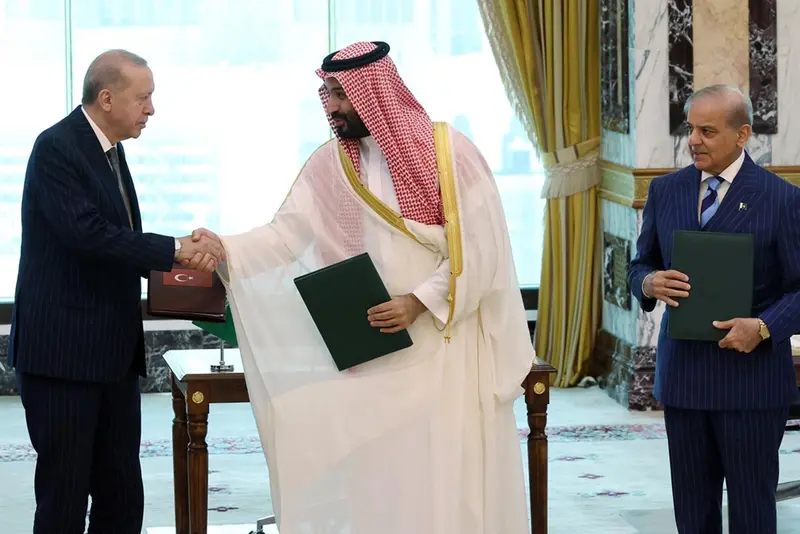
Turkey submitted the Makkah Joint Defence Agreement with Pakistan and Saudi Arabia to parliament for ratification on October 20. The 16-article pact would treat an external armed attack on one signatory as an attack on all three.
Turkish Foreign Minister Hakan Fidan said Turkey and Pakistan were assessing air-defence, electronic-warfare and technical support for Saudi Arabia. He also said Turkey would not send troops into another country to carry out an attack.
Mutual assistance, with limits on its scope
The agreement provides for immediate assistance if a member is subjected to an armed attack or military aggression by another country or group of countries. Each country would determine the form and scale of its support after assessing the needs and its available resources, including military capabilities.
Article 1 also commits the parties to use all necessary means to address threats to a member’s territorial integrity, sovereignty or internationally recognised borders.
The pact was signed in Makkah, the Saudi holy city, on August 7. Its signatories were Turkish President Recep Tayyip Erdogan, Saudi Crown Prince and Prime Minister Mohammed bin Salman, and Pakistani Prime Minister Shehbaz Sharif, according to the agreement detailed by Greek news website iEidiseis.
Saudi defence needs drive talks on support
Earlier in October, the three countries agreed at an emergency meeting in Riyadh to arrange the rapid deployment of military forces and capabilities to Saudi Arabia. The decision came amid attacks on the kingdom by the Houthis, an armed group based in Yemen.
The countries have not specified the forces involved or confirmed whether they have deployed. Fidan said work on possible assistance was continuing, including examining what technical support Turkey and Pakistan could offer.
Turkish and Pakistani officials said the agreement was not directed against Iran or any other country. Its provisions also preserve obligations under earlier international agreements, including Turkey’s commitments to NATO, the transatlantic military alliance.
Joint exercises, intelligence and defence production
The pact extends beyond assistance during an attack. It provides for security consultations, counterterrorism cooperation, personnel exchanges, joint training and exercises, intelligence sharing and logistical support.
It also supports joint defence production and technology development. According to the text detailed by iEidiseis, a Strategic Political and Defence Committee would bring together foreign and defence ministers and military chiefs twice a year.
The committee’s secretariat would be based in Saudi Arabia. Its first secretary-general would come from Pakistan for a three-year term, with the position subsequently rotating among the three countries.
Ratification and deployment need further approval
In Turkey, the parliamentary process begins with examination by the foreign affairs committee, followed by a vote in the full assembly and presidential approval. The agreement takes effect only after all three countries complete their national procedures and deposit the final ratification document.
Even after ratification, sending Turkish troops abroad would require separate parliamentary authorisation, according to iEidiseis. The text it detailed gives the pact an indefinite duration, with withdrawal allowed after 10 years on at least three months’ written notice.

Comments
To comment, sign in or create an account. Sign in Create an account
No comments yet.