

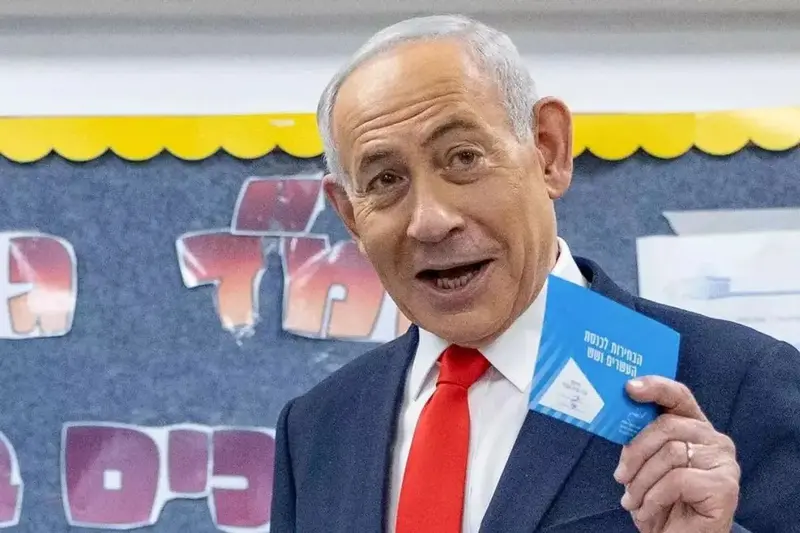
Partial counts after Israel’s October 27 parliamentary election put Benjamin Netanyahu’s bloc ahead but still short of the 61 seats needed for a majority, leaving the country headed for another round of coalition bargaining.
The 120-seat Knesset, Israel’s parliament, rarely produces a clear winner on its own, and the president must eventually ask one lawmaker to try to build a government. This time, the early arithmetic also pointed to record gains for Arab parties, which could complicate every possible coalition path.
Counting points to another hung parliament
As ballots were tallied on Wednesday morning, different snapshots showed Netanyahu’s camp on between 55 and 57 seats, with Gadi Eisenkot’s opposition bloc on 47 to 50. In one count cited by the Greek outlet iEidiseis, based on figures from Israel’s Central Elections Committee, Netanyahu’s bloc had 56 seats after 66% of polling stations had been counted, compared with 48 for Eisenkot’s camp and 16 for Arab parties.
Other reports from earlier or later in the count showed slightly different numbers, but they all pointed in the same direction: Netanyahu’s Likud remained the largest single party, yet neither main bloc had enough support to govern alone. That makes the final count important, but it does not change the basic picture of a tight contest.
Turnout surged as Netanyahu pressed supporters to vote
The election was marked by unusually strong participation. By 2 p.m. local time, turnout had reached 44.9%, the highest level for that hour since 1973, according to the Central Elections Committee. At the close of polls, turnout stood at 77.7%, iEidiseis reported, citing the committee, and described it as the highest in more than 20 years.
Netanyahu spent the day urging Likud supporters to vote and warning that left-wing voters were turning out faster than his own base. He also alleged that people linked to Arab-Israeli parties were trying to buy votes and steal the election. On election night, he called for a strong right-wing government and rejected any coalition that would depend on Arab parties.
Arab parties emerge as potential kingmakers
The biggest projected change was the rise in Arab parties’ representation. Exit polls projected the Joint List, which brings together Hadash, Ta’al and Balad, and Ra’am, the United Arab List led by Mansour Abbas, to win 17 to 18 seats combined, up from 10 in the outgoing Knesset.
That would be enough to make them harder to ignore in the next round of talks. Yusef Yabarín, the Joint List’s president, called the result historic and said the government should go. Abbas said his priority was to bring down Netanyahu, Bezalel Smotrich and Itamar Ben-Gvir.
The Guardian said the enlarged Arab presence could force the opposition to choose between working with Arab lawmakers or leaving Netanyahu a path to political survival. In practice, that means the parties that were least central to the campaign may become central to the math.
What happens next
Once the final count is in, President Isaac Herzog will consult party leaders and choose the lawmaker he thinks has the best chance of assembling 61 votes. If that first attempt fails, the mandate can move to another candidate, and the caretaker government stays in place while negotiations continue.
For now, the election has produced the kind of result that Israel has seen before: a strong political message, but no immediate route to a stable government.


Comments
To comment, sign in or create an account. Sign in Create an account
No comments yet.