

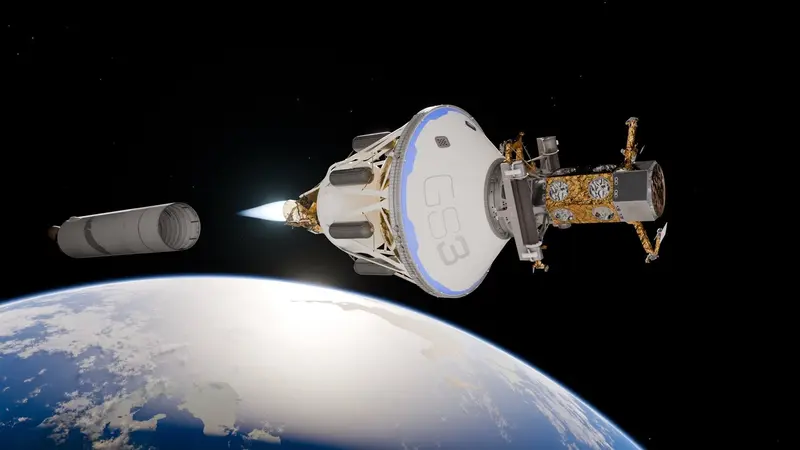
Blue Origin said on November 5 that it is developing a third stage for its New Glenn rocket, which the company says will let the launcher send payloads directly to geostationary orbit and support missions toward the Moon and deep space. An unnamed government customer has booked a GS3 mission to cislunar, or Earth-moon, space, with launch targeted for 2028.
The planned stage changes what New Glenn is designed to do: the rocket currently has two stages, while GS3 would add another option for missions beyond Earth orbit. New Glenn has flown three times so far, each time in its standard 7×2 configuration.
New destinations, different payload figures
Blue Origin says GS3 can fly on both the 7×2 rocket and the larger 9×4 version under development. The stage is designed to fit inside the interstage, the section connecting rocket stages, so it preserves the full volume of the payload fairing.
With GS3, Blue Origin gives the 7×2 a capacity of 8 metric tons directly to geostationary orbit, or 10 metric tons to translunar injection, the trajectory toward the Moon. For the 9×4, the company lists 14 metric tons to geostationary orbit and 20 metric tons to translunar injection.
Those figures describe different destinations from New Glenn’s existing published capacities, which are for geostationary transfer orbit and low Earth orbit. They should not be read as a direct comparison of payload capacity to the same orbit.
New Glenn’s current standard configuration has seven BE-4 engines on its first stage and two BE-3Us on its second. The 9×4 version, with nine first-stage engines and four second-stage engines, is still in development.
A hydrogen tank test for the new stage
GS3 is to use one BE-7 engine, which burns liquid hydrogen and liquid oxygen and is optimized for operations in space. Blue Origin says the stage will rely largely on lightweight composite structures, but hydrogen can escape through small leaks, and strain and temperature changes can cause cracking in composite tanks, exacerbating hydrogen losses.
Limp said the company had been unsure whether a 5.5-meter-diameter composite tank could contain hydrogen at high pressure. Blue Origin then completed its first composite liquid-hydrogen tanking test at Launch Site One in Texas. The company said the tank endured the maximum expected operating level for 2.5 hours and 150% of maximum pressure for 10 minutes.
Blue Origin said the test gave it confidence to proceed with a GS3 design based on composite tanks. The company has not named the government customer, and the 2028 launch is a target rather than a specific date.
Northstar is a separate engine upgrade
Blue Origin also announced Northstar, a new first-stage engine that burns liquid oxygen and liquid methane. The company says it is less complex than the BE-4, with 30% less mass and 50% fewer parts, while increasing thrust from 640,000 to 715,000 pounds-force.
Blue Origin says manufacturing advances allow Northstar to be assembled in less than a day, and that the engine moved from program approval to development testing in 11 months. The company did not give a date for its first flight.




Comments
To comment, sign in or create an account. Sign in Create an account
No comments yet.