
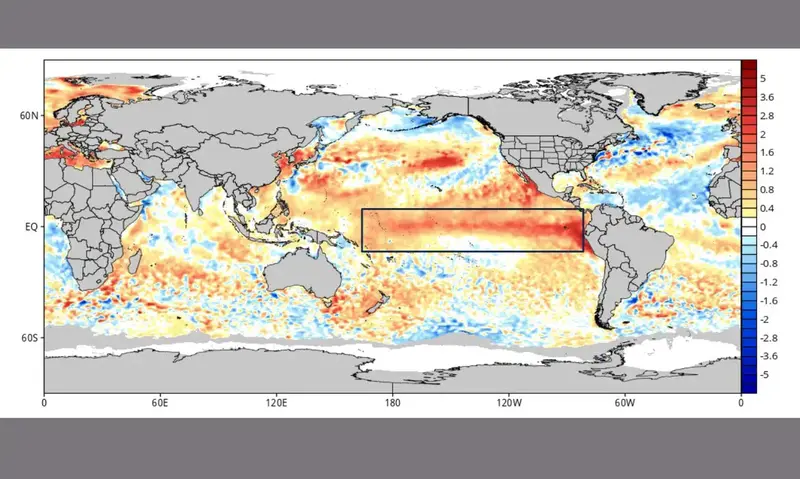
A Brazilian scientific panel has put the probability at 95% that the 2026–2027 El Niño will reach “very strong” intensity during the October–December quarter. If that forecast is confirmed, the episode could rank among the most intense El Niño events recorded since 1950.
The assessment appears in the fourth bulletin of the El Niño 2026–2027 Panel, coordinated by Brazil’s National Institute for Space Research, or Inpe. The period covers spring and the beginning of summer in the Southern Hemisphere.
Pacific warming underpins the forecast
Data from the U.S. Climate Prediction Center and the National Oceanic and Atmospheric Administration indicate that sea-surface temperature anomalies in the central and eastern equatorial Pacific exceeded 2°C at the end of September.
El Niño is characterized by abnormal warming of surface waters in the equatorial Pacific. The change can modify atmospheric circulation and influence the distribution of rainfall and temperatures in different regions. The current bulletin combines meteorological, climatic and hydrological information to assess possible effects in Brazil.
Contrasting rainfall outlook across Brazil
The panel expects rainfall above the historical average in southern Brazil during the October–December period, with the possibility of flooding. More frequent or intense rain could increase attention around rivers, flood-prone areas and other vulnerable locations, including parts of Santa Catarina.
Above-average rainfall is also forecast for parts of the Southeast and eastern Northeast. The outlook differs in central-northern Brazil, where conditions are expected to be drier and the risk of fires higher.
Higher temperatures and drought risks
In the North and Northeast, less frequent rainfall together with elevated temperatures could worsen drought conditions and increase the risk of forest fires. Temperatures are expected to remain above average across much of Brazil.
The bulletin was prepared by Inpe in partnership with the National Institute of Meteorology, the National Water and Basic Sanitation Agency, the National Center for Monitoring and Alerting of Natural Disasters, the Geological Survey of Brazil, the National Secretariat for Civil Protection and the Management and Operational Center of the Amazon Protection System.


Comments
To comment, sign in or create an account. Sign in Create an account
No comments yet.